ISO 14001 certification is global proof that a business has successfully established and implemented an Environmental Management System in accordance with international standards. This certification helps organizations not only control and minimize negative environmental impacts, but also enhance brand image, meet legal requirements, and satisfy global partners. Millions of businesses worldwide have adopted ISO 14001 to optimize operational efficiency, reduce costs, and expand business opportunities in a sustainable and environmentally responsible manner.

SQC CERTIFICATION VIETNAM PROVIDES ISO 14001 CERTIFICATION SERVICES
- ISO 14001 certification is globally recognized through the marks of UAF and IAF
- Helps businesses optimize costs and comply with domestic and international regulations
- Experienced auditors provide dedicated support to clients
- Delivers long-term benefits for businesses
ISO 14001 – ENVIRONMENTAL MANAGEMENT SYSTEM
ISO 14001 is an international standard for Environmental Management Systems (EMS), issued by the International Organization for Standardization (ISO). In Vietnam, this standard has been adapted and applied under the name TCVN ISO 14001. It was first introduced in the 1990s and is now widely implemented across many industries and sectors.
Versions of ISO 14001
- ISO 14001:1996 – Issued in 1996 as the first original version of the ISO 14001 standard. It focuses on helping organizations control environmental impacts and comply with legal requirements.
- ISO 14001:2004 – Released in 2004 with updates to clarify requirements and improve implementation effectiveness.
- ISO 14001:2015 – Issued in September 2015 and is the most current version to date.
ISO 14001:2015 is currently the most widely used version worldwide, playing a crucial role in helping organizations improve environmental management effectiveness.
WHAT IS ISO 14001 CERTIFICATION?
ISO 14001 certification is the process of evaluating and confirming that an organization’s Environmental Management System (EMS) fully meets the requirements of the ISO 14001 international standard. This assessment is carried out by an authorized certification body that is widely recognized globally. The objective of certification is to ensure that the organization is applying an effective, controlled environmental management system and complying with environmental protection principles in accordance with international standards.
The Significance of the ISO 14001 Certificate
The ISO 14001 certificate – also known as ISO 14001 certification – is verified proof that an organization has undergone a comprehensive evaluation process, addressed any nonconformities (if any), and has been recognized as compliant with the ISO 14001 standard. This certificate is a document with both legal and commercial value, issued by independent certification bodies and recognized globally. Obtaining this certification demonstrates a company’s commitment to sustainable development and environmental responsibility.
TARGET AUDIENCE FOR ISO 14001:2015 CERTIFICATION
In principle, ISO 14001 is a voluntary standard. The standard itself does not impose mandatory requirements for implementation. However, in practice in Vietnam, under Decree 40/2019/ND-CP (guidelines for the Law on Environmental Protection), businesses involved in production, manufacturing, and services – especially those in industries with high environmental pollution risks – are required to apply ISO 14001. These include:

Group 1 – Industries with high environmental impact risks
- Mining and processing of toxic minerals
- Metallurgical and toxic mineral refining facilities
- Paper, pulp, and fiberboard manufacturing plants
- Chemical, pesticide, and chemical fertilizer production plants
- Textile dyeing and fabric washing industries
- Oil refineries and petrochemical plants
- Power generation from coal, coal gasification, nuclear power, coke production, etc.
Group 2 – Processing and consumer manufacturing industries
- Rubber processing
- Production of alcohol, beer, MSG, cassava starch, industrial alcohol
- Sugar processing
- Seafood, livestock, and poultry processing
- Manufacturing of electrical and electronic components and equipment
Group 3 – Recycling and waste treatment industries
- Waste treatment, recycling, or use of imported scrap materials
- Electroplating and chemical surface treatment processes
- Battery and accumulator production
- Clinker production
Achieving ISO 14001:2015 certification not only helps businesses comply with legal requirements but also reduces environmental risks, lowers treatment costs, and enhances brand value in the eyes of partners and the community.
ISO 14001 CERTIFICATION PROCESS AT SQC CERTIFICATION VIETNAM
With the goal of supporting organizations and businesses in building and effectively operating an environmental management system in accordance with ISO 14001:2015, SQC Certification Vietnam implements the certification process as follows:
Step 1: Establish an Environmental Management System (EMS) in accordance with ISO 14001:2015
Businesses begin by building a complete EMS that fully meets the requirements of ISO 14001:2015. Key tasks include:
- Assessing the current status and organizational readiness
- Demonstrating strong commitment from top management to implement the standard
- Defining environmental objectives and the scope of the EMS
- Establishing an ISO team and clearly assigning responsibilities to relevant personnel
Organizing training programs to raise awareness of ISO 14001 and develop skills for system documentation and operation

Step 2: Submit application for certification
Once the environmental management system is completed, the business prepares and submits an application dossier to an authorized certification body. The dossier includes required documents in accordance with prescribed templates to prepare for the official audit.
Step 3: Contract signing and audit planning
The business and the certification body sign a contract to agree on the audit scope, implementation plan, costs, and related terms. This step ensures close coordination during the certification process.
Step 4: Certification audit (2 stages)
The audit process is conducted in two stages:
- Stage 1: Documentation review and system readiness assessment
- Stage 2: On-site audit to verify implementation and operation
After the audit, the business will receive a report summarizing conformities and nonconformities (if any), along with corrective action requirements before proceeding to the next steps.
Step 5: Application Review
The certification body will conduct a thorough review of all documentation, processes, and implementation evidence to ensure that the company’s Environmental Management System (EMS) fully meets the requirements of ISO 14001:2015.
Step 6: Issuance of ISO 14001:2015 Certificate
After all nonconformities (if any) have been fully corrected, the certification body will issue the ISO 14001:2015 certificate to the business. The certificate is valid for three (3) years and serves as clear proof of environmental management capability meeting international standards.

Step 7: Periodic Surveillance Audits
During the validity period of the certificate, the business will undergo periodic surveillance audits (typically annually) to verify compliance and the effectiveness of maintaining the environmental management system in accordance with ISO 14001:2015.
Step 8: Recertification Audit
Before the certificate expires, the business must undergo a recertification audit. This process is similar to the initial certification audit and ensures the continued conformity of the EMS in the next cycle.
RECOMMENDATIONS FROM SQC CERTIFICATION FOR BUSINESSES
To quickly achieve ISO 14001:2015 certification, businesses must fully implement the standard’s requirements and clearly understand the key points that Certification Bodies (CB) will focus on during the audit. Below are important notes to keep in mind:
Clearly define the scope of the environmental management system
- The certification body will assess whether the scope of application aligns with the company’s scale, products/services, and actual environmental impacts.
- The scope must be clearly defined in the environmental policy and official company documentation.

Identify environmental aspects and impacts comprehensively
- This is a core requirement of ISO 14001. Businesses must conduct environmental assessments to identify aspects such as electricity usage, emissions, waste generation, noise, etc.
- The certification body will review the evaluation methods and criteria used to determine significant environmental aspects.
Ensure a clear and well-communicated environmental policy
- The environmental policy is a mandatory document when implementing ISO 14001. It must include commitments to environmental protection, legal compliance, and continuous improvement.
Comply with environmental laws and regulations
- Businesses must identify and regularly update all applicable environmental regulations (e.g., wastewater, emissions, noise, fire prevention, etc.).
Certification bodies typically review:
- List of applicable legal requirements
- Periodic monitoring records (water, air, waste, etc.)
- Environmental measurement results
- Environmental commitment reports or Environmental Impact Assessment (EIA) documents
Set appropriate and measurable environmental objectives
- The certification body will verify whether the company has set specific and measurable objectives (e.g., reducing electricity consumption by 10% per year, increasing waste recycling rates, etc.).
- There must also be action plans, assigned responsibilities, and progress monitoring.

Provide training and raise environmental awareness
- The certification body will evaluate whether employees are properly trained and understand their roles within the environmental management system.
- Training records must be maintained, especially for positions related to waste management, chemical handling, and operation of pollution-generating equipment.
Internal Audits and Management Review
Similar to ISO 9001, the certification body requires:
- At least one internal audit before certification
- Management review demonstrating commitment from senior management
- Complete documentation with recorded improvements.
Waste Management and Environmental Incident Response
- The certification body will inspect how the business collects, sorts, stores, and treats waste.
- An environmental incident response plan (oil spills, chemical leaks, etc.) and drills (if any) are required.
- Hazardous waste handover records and contracts with treatment facilities must be valid.
Complete and accurate record keeping
- Records must be properly maintained, showing that the business is implementing environmental management practices, not just going through the motions.
Maintaining Continuous Improvement and Tracking Goals
- ISO 14001 is not a “mark-and-run” system but requires continuous improvement. The certification body will also monitor the implementation of environmental goals through annual surveillance audits.
REASONS TO CHOOSE SQC CERTIFICATION VIETNAM
SQC Certification Vietnam is a member of SQC Certification India and has a global presence, including Vietnam. We are proud to partner with thousands of businesses on their journey to establish their position and integrate internationally.
At SQC Certification Vietnam, we pride ourselves on certifying organizations and promoting a culture of continuous improvement through Advanced Management Systems Assessment and Training programs. SQC Certification Vietnam has been and continues to be a trusted choice for many large and small organizations nationwide in achieving ISO 14001 certification.
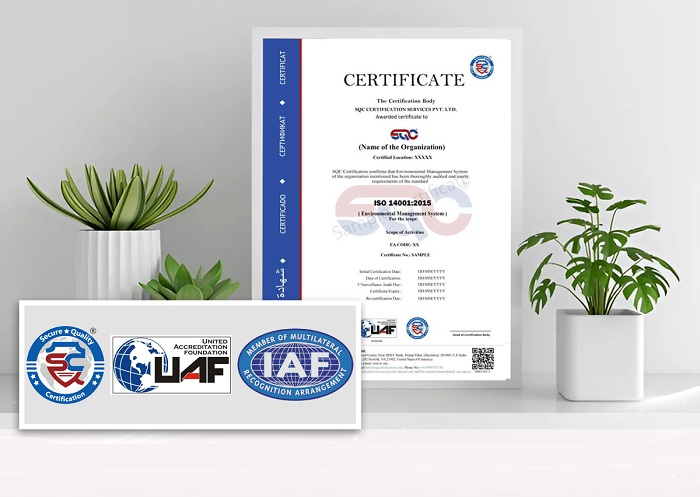
We have a team of leading domestic and international experts with extensive experience who will bring practical value and the most professional experience to our customers.
Customers using SQC Certification Vietnam’s services will receive:
- A scientific, transparent, and professional assessment process
- Fast and efficient procedures, maximum support throughout the certification process
- All-inclusive pricing, no unexpected costs
- 24/7 support service – Dedicated and responsible partnership
- Attractive after-sales policy – Exclusive offers for loyal customers
Contact Information:
Let SQC Certification Vietnam help your business achieve international standards professionally and sustainably.
- Hotline: 0936396611
- Website: https://sqccert.com.vn/
- REGISTER NOW: https://forms.gle/ydn9rzk5H7jrrf9g9
 What is a SOC 2 Report? A Guide to SOC 2 Reporting for Technology Businesses
 Latest Updates to SOC 2 for Businesses in 2026
 Free Training Course: HIGG FEM Assessment Toolkit and Latest Updates
 SQC Certification Vietnam officially becomes a QSAC authorized by PCI SSC.
 What is a QSA? The Role of a QSA in the PCI DSS Assessment Process
 Comparison of ISO 27001 vs ISO 27002: Similarities and Differences